The essential toolkit for every vanlifer
You don't need to drag a full garage with you to solve small problems on the road. But leaving completely unprepared isn't smart either. A loose screw, a blown fuse, a small leak, a bike part coming loose, or a cable that suddenly stops working: these are things that won't immediately ruin your trip, as long as you have a few basic items with you.
By Laurens De Leeuw · 14 July 2026
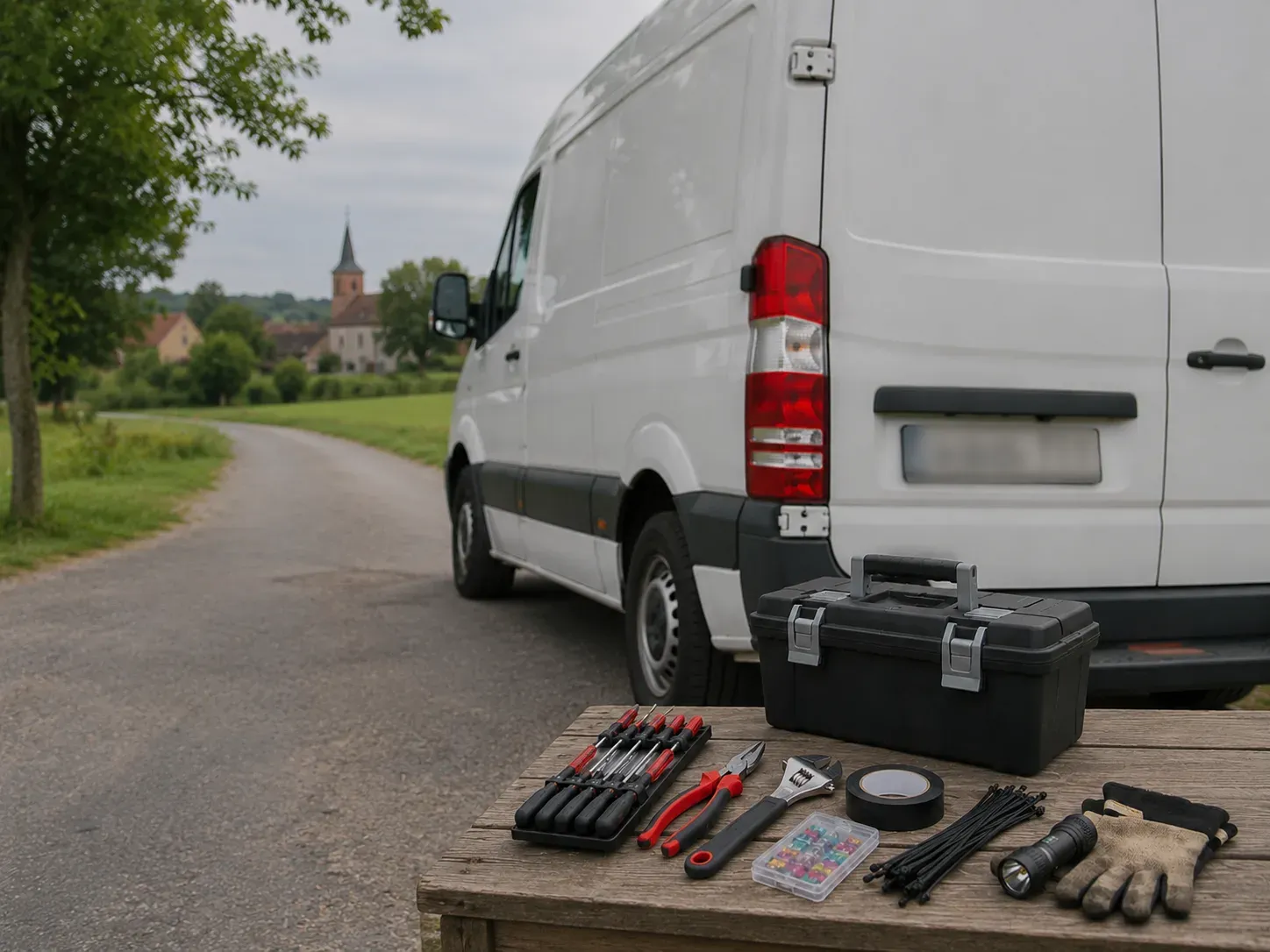
You don't need to drag a full garage with you to solve small problems on the road. But leaving completely unprepared isn't smart either. A loose screw, a blown fuse, a small leak, a bike part coming loose, or a cable that suddenly stops working: these are things that won't immediately ruin your trip, as long as you have a few basic items with you.
The best toolkit for vanlife is therefore not the largest. It's the one that's compact, logically assembled, and helps you with the small, realistic problems that actually occur on the road.
Especially in a van, where you're driving a vehicle, a small living space, and often some technology all at once, a basic set is not an unnecessary luxury. Not for making major repairs in a parking lot, but for dealing with small problems before they become annoying.
Why every vanlifer needs a basic toolkit
Many people immediately think of engine problems or heavy mechanics when they think of tools. But in practice, you usually use your tools for much simpler things on the road.
Think of:
- a cabinet hinge coming loose
- a bed slat creaking
- a bike rack that needs tightening
- a fuse blowing
- a water coupling dripping
- a light bulb that needs replacing
- a screw vibrating loose
- a clamp that needs to be secured
- a cable that needs to be rerouted
- a battery terminal or post that needs checking
- a hook or door magnet that's loose
These aren't major disasters, but they can become irritating if you don't have anything with you.
I personally find this one of those typical vanlife lessons: you don't have to be able to fix everything, but you do want to have enough with you so you don't feel helpless for every small problem.
Think in three types of materials
A good vanlife toolkit actually consists of three parts:
1. basic hand tools
2. small consumables
3. emergency supplies and temporary solutions
This distinction is useful, because a screwdriver alone won't help much if you don't have spare fuses or tape. And conversely, loose zip ties are of little use if you don't have pliers or a knife.
Part 1: Basic hand tools
This is the core of your kit. Not an overly extensive workbench, but the things you use most often.
1. Screwdrivers or bit set
A good bit set with a holder is usually smarter than five loose screwdrivers. This way you take up less space and still have different heads with you.
Useful are:
- Phillips head
- flat head
- Torx bits
- Allen bits
- possibly a small ratchet screwdriver
In a van, you often encounter different types of screws, especially if you have a self-build, bicycle equipment, accessories, or furniture.
2. Combination pliers
Combination pliers are truly a basic item that you'll use more often than you think.
Useful for:
- gripping something
- bending wire
- clamping
- holding small parts
- pulling something loose
- cutting small cables
3. Needle-nose pliers
Not mandatory, but handy. Especially in small corners or for fuses, clips, cables, and hard-to-reach parts.
4. Side cutters
For zip ties, small cables, and wires, side cutters are much neater and handier than scissors.
5. Adjustable wrench
An adjustable wrench is compact and useful for all kinds of bolts and couplings. Not perfect for everything, but very handy for a basic set.
6. Small socket set or ratchet set
If you want to go a bit further, a compact socket set is very useful. Especially for small vehicle or mounting materials.
Choose a small, decent set rather than a gigantic, cheap case you'll never use.
7. Allen wrenches
Many things on a van, bike, or accessory use Allen bolts. Think of bike racks, chairs, furniture, tables, shelves, and technical fastenings.
A compact set of Allen wrenches takes up little space and is almost always useful.
8. Torx set
Many vehicles and accessories use Torx. If you want to adjust something on your van, interior, or mounting points, a Torx set is often handy.
9. Hammer
A small hammer is sufficient. Not for major constructions, but for tapping something loose, securing a pin, or carefully adjusting a part.
10. Tape measure
Sounds trivial, but is surprisingly handy on the road. For items, adjustments, replacements, containers, temporary fixes, and small storage problems, a tape measure is simply practical.
11. Spirit level
A small spirit level can be handy, especially if you sometimes adjust something or want to do a simple check. Not absolutely necessary, but useful.
12. Utility knife or sturdy folding knife
For packaging, tape, cardboard, rope, pipes, and small jobs, a decent knife is almost indispensable.
Keep it safe, though. Not loose in a bin where you blindly grab.
13. Scissors
Simple, sturdy scissors are often quicker and handier than a knife for light tasks.
Part 2: Small consumables
This is the part that many people forget. Yet, it's often these small items that you need most quickly.
14. Spare fuses
If you work with electricity in your van at all, spare fuses are standard in your kit.
Take the types that are actually used in your vehicle or build. Not "a few random ones," but the correct sizes and values.
A small blown fuse can otherwise cause a lot of frustration.
15. Electrical tape
Electrical tape is light, cheap, and often handy. Not as a permanent solution for everything, but for small emergencies or temporary protection.
16. Duct tape
The classic. Not a miracle cure, but extremely useful.
For temporary solutions such as:
- securing something
- sealing something
- bundling something
- temporarily protecting a damaged part
- temporarily fixing a flap or panel
Don't use it to make bad solutions permanent, but as emergency aid, it's great.
17. Zip ties
Zip ties are worth their weight in gold in a van.
They help with:
- bundling cables
- temporarily securing something
- organizing loose items
- temporarily replacing a broken clamp
- improvising small fastenings
Take different sizes with you. And preferably a few stronger ones too.
18. Spare screws, nuts, and washers
Keep a small assortment of the sizes you use most often in your own van. Not a gigantic stock, but a small box with useful basics.
If you've ever had a cabinet, hook, or panel come loose, you know how handy this is.
19. Spare bolts for your specific build
Do you have a bike rack, solar panel mounting, bed frame, seat base, or special furniture that is secured with specific bolts? Take a few spare ones with you.
That's smarter than twenty general bolts that ultimately don't fit anywhere.
20. Small tube of superglue
For small repairs, superglue can be handy. Not for structural things, but for small plastic parts, clips, or temporary fixes.
21. Mounting adhesive or strong glue
Only in small quantities and well-sealed. Handy if something ever comes loose that isn't screwed. Not essential for everyone, but useful for self-builds.
22. Teflon tape
If you work with water pipes, taps, or couplings, Teflon tape is small and useful. A small leak or a coupling that needs to be reinstalled can sometimes be quickly resolved with it.
23. Spare light bulbs
Not every modern van still uses simple light bulbs, but if your vehicle or interior does, a small reserve stock can be handy.
24. Spare batteries
For flashlights, CO detectors, smoke detectors, remote controls, or small devices, this is smart to bring along.
Part 3: Emergency supplies and temporary solutions
These aren't always "tools," but they are things that can make your trip much easier.
25. Work gloves
Dirty hands are annoying, but cuts or burned fingers are even more so. A decent pair of work gloves takes up almost no space and is always handy.
26. Flashlight or headlamp
If you ever need to check something in the evening or in the dark, you'll be glad you have this. A headlamp is extra handy because it keeps your hands free.
27. Multimeter
For those who are somewhat involved with the electrical installation, a simple multimeter is very useful. You don't have to be an expert to check basic things with it like battery voltage, fuses, or simple power problems.
If you do nothing with electricity at all, this is less urgent. But for many vanlifers, it is still a useful tool.
28. Tire pressure gauge
Not mandatory if you check at gas stations, but handy. Especially if you drive a lot with varying loads.
29. Small air compressor
This is technically not a standard part of a toolkit, but for vanlife, I consider it a strong addition. Especially if you often stay in remote places, travel with bikes, or regularly want to maintain your tire pressure.
30. Jumper cables
Still useful for many vehicles. If you have a starting problem or want to help someone else, you'll be glad you have them.
31. Tow eye or knowledge of where it is
Not really a tool, but handy to know where it is and how it works.
32. Small shovel or brush
For mud, snow, sand, or dirt around your wheels, this can be practical. Especially if you often stay in unpaved places.
Make your toolkit vanlife-specific too
The perfect basic set also depends on what your van looks like.
A few examples:
Do you have a self-built interior?
Then extra screws, wood screws, hooks, furniture parts, and some spare fittings are smart.
Do you have an electrical system?
Then spare fuses, cable lugs, some heat shrink tubing, and a multimeter are more interesting.
Do you have a water system?
Then hose clamps, Teflon tape, and perhaps a spare coupling are useful.
Do you travel with bikes?
Then some bike tools also belong in your kit, such as:
- tire levers
- inner tube
- small bike pump
- multi-tool
- chain tool if you want to go further
- specific Allen key sizes
Do you travel with a dog?
Then you might have less need for extra technical tools, but you will need a small extra towel, brush, zip ties, and material to temporarily fix a broken leash or hook.
Keep your tools compact
The mistake many beginners make is taking too much with them.
You don't need a full workbench. Large, heavy cases take up a lot of space and make your van unnecessarily heavy. Chances are you'll never use 80 percent of it.
Better is:
- one compact tool bag
- one small box with consumables
- possibly one extra technical pouch for electrical or water items
This keeps everything organized.
Choose quality over quantity
A cheap set of a hundred pieces sounds nice, but on the road, you'd rather have a few decent tools that don't immediately strip, bend, or break.
You don't have to buy professional top-tier material, but avoid truly junk quality. Especially with things like screwdrivers, pliers, and knives, you'll quickly notice the difference.
One decent pair of combination pliers is better than three bad ones.
Give everything a fixed place
As with everything in a van, organization is at least as important as the contents.
You don't want to have to open three bins on a rainy evening to find one Allen key.
Therefore, keep:
- tools together
- consumables separate
- sharp items safely stored
- frequently used tools easily accessible
- spare parts labeled
- loose screws in small boxes
A soft tool bag often works better than a hard case, as it rattles less and fits more easily somewhere.
Things you'd better not take with you as standard
Not everything is needed in a basic toolkit.
For most vanlifers, these things are usually overkill:
- heavy drill if you never use it
- large angle grinder
- full-size wrench set of enormous proportions
- heavy bench vise
- gigantic hammer
- large quantities of paint, glue, or sealant
- complete twenty-kilo garage toolbox
Unless you really build or repair a lot on the road, that's mostly ballast.
A smart minimum version
If you really want to keep it compact, a minimal basic set could look like this:
- bit set or screwdriver with bits
- combination pliers
- side cutters
- adjustable wrench
- Allen wrenches
- knife
- duct tape
- zip ties
- spare fuses
- small roll of electrical tape
- work gloves
- flashlight
- spare screws
- Teflon tape if you have a water system
You'll get surprisingly far with that.
My practical ideal basic set
If I were to put together a compact but useful toolkit for a regular Belgian vanlife trip, I would take this:
- compact bit set
- small ratchet set
- combination pliers
- side cutters
- adjustable wrench
- Allen key set
- knife
- scissors
- tape measure
- flashlight or headlamp
- work gloves
- spare fuses
- duct tape
- electrical tape
- zip ties
- small box with screws and nuts
- Teflon tape
- multimeter
- small air compressor
- jumper cables
That's not an extreme amount, but it's enough to tackle most small problems on the road without your whole bus becoming a mobile workshop.
Don't forget safety
Tools are handy, but safety always comes first.
Do not use damaged tools. Do not improvise on brakes, airbags, seat belts, or structural vehicle components if you don't know what you're doing. And be extra careful with gas, electricity, and fuel.
A toolkit is primarily for solving small problems, securing things safely, and making temporary solutions until you can make a real repair.
Sometimes the smartest tool is still calling roadside assistance.
Your toolkit grows with your experience
Your first toolkit doesn't have to be perfect.
After a few trips, you'll naturally notice what you use and what never leaves the bag. Maybe you're missing an extra Torx size. Maybe you use zip ties remarkably often. Maybe that big wrench turns out to be superfluous and you'd prefer a better flashlight.
That's normal.
The best toolkit doesn't come from a perfect list, but from experience.
You don't want to be able to do everything, just the basics
The basic toolkit for every vanlifer doesn't have to be big or expensive. It mainly needs to be logical.
With a few decent hand tools, some spare fuses, tape, zip ties, small fasteners, and a few emergency supplies, you can solve many small problems on the road. That doesn't immediately make you a mechanic or converter, but it does make you much more independent.
And that's ultimately the goal.
Not to open a full garage on the road, but to have enough with you so that a loose screw, dripping coupling, or small electrical malfunction doesn't immediately throw your trip off balance.
Source: https://www.politie.be/5415/vragen/verkeer/met-de-wagen-op-reis-checklist
Source: https://www.politie.be/5415/vragen/verkeer/veilig-op-reis-met-caravan-of-kampeerwagen
Source: https://www.anwb.nl/kamperen/camper/onderweg/met-de-camper-op-pad-checklist
Source: https://www.victronenergy.com/media/pg/The_Wiring_Unlimited_book/en/index-en.html