The basic check before you leave with your van
Leaving with your van always feels a bit like freedom. You throw in the last few items, slide the door shut, turn the key, and off you go. But precisely because a van is simultaneously a vehicle, bedroom, kitchen, storage space, and sometimes even an office, it pays to consciously check that everything is in order before departure.
By Laurens De Leeuw · 14 July 2026
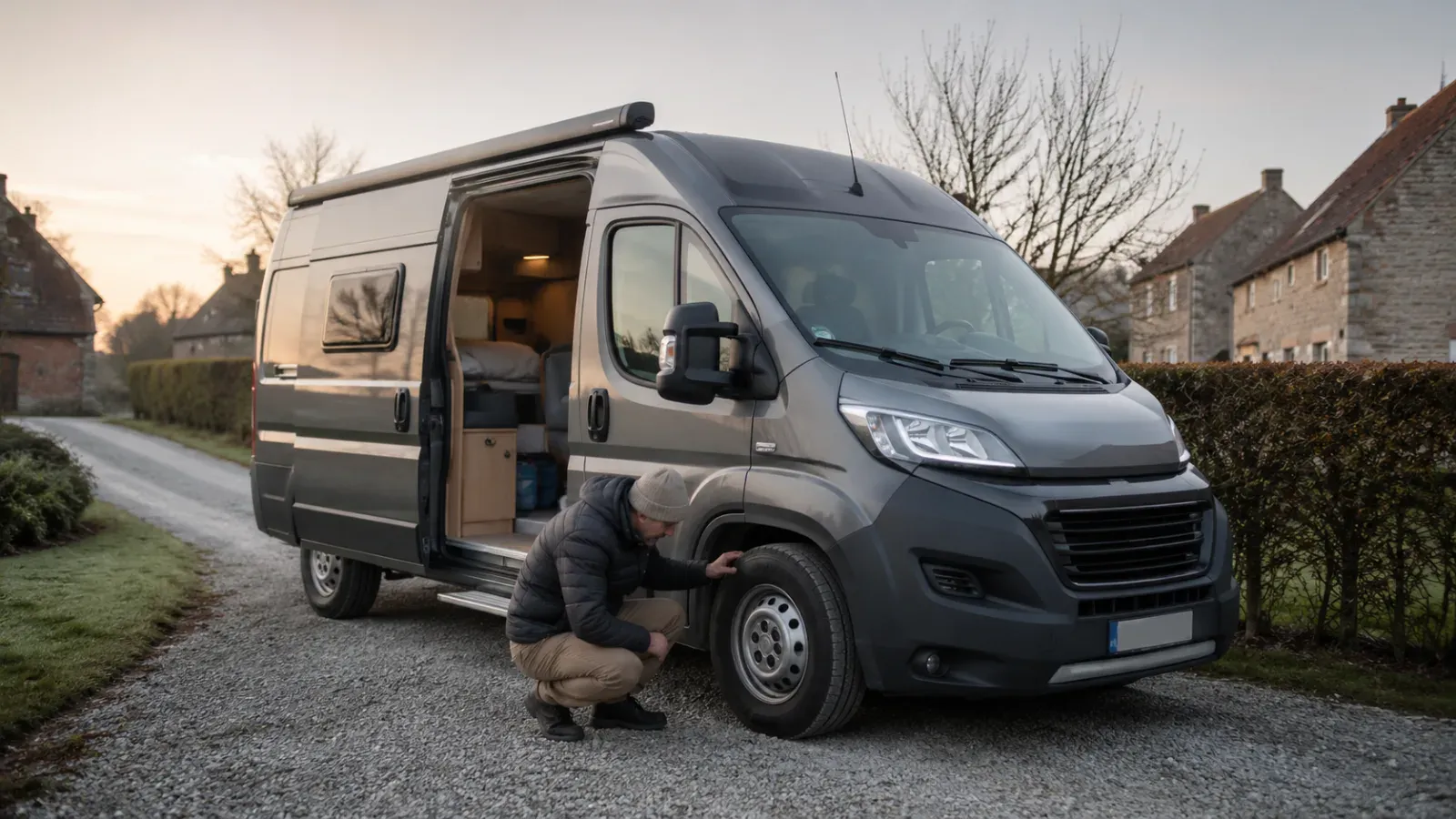
Leaving with your van always feels a bit like freedom. You throw in the last few items, slide the door shut, turn the key, and off you go.
But precisely because a van is simultaneously a vehicle, bedroom, kitchen, storage space, and sometimes even an office, it pays to consciously check that everything is in order before departure.
Not in an exaggerated way. You don't need to play technical inspector for every weekend trip. But a simple basic check can prevent a lot of misery: an empty windshield washer, underinflated tires, a cupboard flying open, a loose gas bottle, a dead power bank, a forgotten driver's license, or a roof hatch that's still open.
A good pre-departure check usually only takes a few minutes. And the more often you do it, the more automatic it becomes.
Why a pre-departure check is so important
You usually use a regular car to drive from point A to point B. You use a van differently. You stop more often, drive with more weight, carry more loose items, sometimes have water, gas, electricity, cooking equipment, bicycles, dog supplies, bedding, and tools with you.
This makes your vehicle more susceptible to small errors.
A loose water bottle is annoying. A loose heavy box under your bed becomes dangerous during hard braking. A soft tire can affect your road holding. A poorly closed roof hatch can blow open on the road. A cupboard flying open on a bend is not only irritating but can also cause damage.
For me, a pre-departure check is primarily about peace of mind. I much prefer to leave five minutes later with the feeling that everything is in order, than to have to wonder on the way: did I actually turn off that gas bottle?
Think in three types of checks
Not every check needs to be equally extensive every time.
It's better to work with three levels.
The quick check for every trip
You actually do this every time before you leave, especially if you've slept somewhere or been stationary for a while.
Think of:
- doors closed
- sliding door properly closed
- rear doors closed
- windows closed
- roof hatch closed or in safe driving position
- cupboards and drawers locked
- loose items secured
- gas off
- cooking equipment stored
- power cable disconnected
- step stored inside
- trash taken out
- mirrors adjusted correctly
- phone and keys at hand
This is the one-minute check. Ideal for departing from a campsite, parking lot, camper spot, or driveway.
The weekend check
Before you go away for a weekend or a few days, you check a bit more extensively.
In addition to the quick check, you also check:
- tire pressure
- tire tread and visible damage
- oil level if applicable
- coolant
- windshield washer fluid
- lighting
- windshield wipers
- mandatory equipment
- vehicle documents
- water
- battery
- gas or cooking fuel
- food and trash bags
- toilet or hygiene items
- first aid kit
- weather forecast
- route and sleeping spot
This sounds like a lot, but if everything has a fixed place, you'll get through it quickly.
The long journey check
For a longer trip or a trip abroad, you go a step further.
Then you also look at:
- validity of inspection
- insurance and breakdown assistance
- travel documents
- rules in countries you drive through
- environmental zones
- tolls, vignettes, or registration
- tires suitable for season and destination
- spare parts
- medicines
- pet documents if traveling with a dog
- child seats and documents if traveling with children
- payload and weight
- maintenance that is almost due
- emergency numbers and offline maps
The further you drive, the more annoying small problems become. A missing document or a bad tire is quickly resolved at home. On the road abroad, that becomes much more difficult.
Start with your documents
Before you leave, it's best to first check if your documents are in order. That's boring, but important.
In Belgium, as a driver, you must carry your driver's license and identity card, among other things. The correct vehicle documents, such as the insurance certificate, registration certificate, inspection certificate, and certificate of conformity, must also be present in the vehicle.
So check:
- driver's license
- identity card
- insurance certificate
- registration certificate
- inspection certificate
- certificate of conformity or COC
- any additional certificates if applicable to your vehicle
- documents for trailer, bike rack, or special equipment if relevant
Store them in a fixed place. Not loosely in a jacket, not somewhere among cooking supplies, and not in a bag you leave at home.
A waterproof folder or fixed document bag in the glove compartment works great. You can also make digital copies, but don't rely solely on them. Some documents you simply have to be able to show.
Also check the mandatory equipment
According to Flanders, four items must be present in your vehicle:
- warning triangle
- fire extinguisher
- high-visibility vest
- first aid kit
That's the legal basis. But for a van, I would think a bit more broadly.
I would personally at least bring:
- warning triangle
- fire extinguisher that is still valid
- high-visibility vest, preferably for every occupant
- first aid kit
- flashlight or headlamp
- work gloves
- power bank
- charging cable
- roll of trash bags
- basic tools
- duct tape
- tie-down straps or bungee cords
- spare fuses if relevant
- microfiber cloth
- tire pressure gauge if you have one
Pay particular attention to the fire extinguisher. It must not only be present but also usable. So check the expiration date occasionally and ensure it's easily accessible.
A fire extinguisher under three boxes in the back may technically be “with you,” but practically useless if you need it quickly.
Do a walk-around of your van
Before you get in, walk once around your vehicle.
Don't look fleetingly, but consciously. You're not looking for small scratches. You're looking for anything obviously wrong.
Pay attention to:
- are all tires normal?
- is there no flat or very soft tire?
- is there no oil, coolant, or water under the van?
- are there no loose cables, ropes, or straps?
- are bicycles, roof racks, or accessories properly secured?
- are windows, doors, and hatches closed?
- is the license plate still securely attached?
- are lights visible and not covered?
- is there nothing in front of or behind the wheels?
- is there no block, step, chair, or cable outside?
This walk-around is especially important after a night's sleep or after a long break. You might have put something outside, left something hanging, or someone parked close to your van.
With a dog like Grephar, I would also always check if his leash, water bowl, or towel isn't still outside. These are those small things you only notice when you're already on your way.
Tires: small contact patch, big difference
Tires are one of the most important checks.
Your entire van only touches the road with four small contact patches. And with a converted van, those tires are often more heavily loaded than with an empty delivery van.
Check:
- tire pressure
- tread
- cracks
- bulges
- nails or foreign objects
- uneven wear
- spare wheel or repair kit
- valve caps
- correct tire for season and weight
The FPS Public Health advises checking tire pressure and wear every month. It also states that 1.6 mm is the legal minimum for tread depth, but replacement below 3 mm is recommended.
With a van, I wouldn't be too nonchalant about that. You often drive with more weight, sometimes on wet roads, cobblestones, muddy parking lots, or steep slopes. Good tires provide peace of mind.
Check tire pressure preferably when cold, i.e., before you've driven for a long time. Consult your manual or the sticker in the vehicle for the correct pressure for your load. A heavily loaded van often needs different tire pressure than an empty delivery van.
Don't forget your spare wheel or repair kit
Many people check their four tires but forget their spare wheel.
If you have a spare wheel, check if it's usable and at the correct pressure. If you don't have a spare wheel but a tire repair kit, check if it's still present and usable. Some kits have an expiration date.
Also consider if you know how to use the system. On the road in the rain next to a busy road is not a good time to figure out where your jack is for the first time.
Lighting and visibility
Seeing and being seen is basic safety.
Check regularly:
- low beams
- high beams
- taillights
- brake lights
- turn signals
- fog lights
- license plate lighting
- side marker lights if present
- reverse lights
For brake lights, it's helpful if someone watches. Alone, you can use reflection in a window or wall.
Also clean your windows, mirrors, and lights. Especially in winter or after muddy rides, lights quickly get dirty. A working light completely covered in dirt does its job less well.
Also check your windshield wipers. Streaks, noise, or hard rubber are signs that they need replacement. And make sure your windshield washer fluid is filled. Nothing is as irritating as a dirty windshield and an empty washer fluid tank.
Fluids under the hood
You don't have to be a mechanic, but almost anyone can learn a few basic checks.
Check regularly:
- engine oil
- coolant
- brake fluid
- windshield washer fluid
- power steering fluid if applicable
- AdBlue if your diesel vehicle uses it
Use your vehicle's manual. Not every van is the same, and some checks need to be done on a cold or level engine.
Be careful with coolant. Never just open a cap when the system is hot. That can be dangerous.
Do you suddenly see a low level, leakage, or a warning light? Don't ignore it because you're “just going for a short trip.” Small problems often become bigger on the road.
Start consciously
When you start the engine, listen and look carefully.
Pay attention to:
- does it start normally?
- do any warning lights remain on?
- does the engine sound different than usual?
- do you smell anything strange?
- do you feel vibrations?
- do the brakes work normally?
- does the steering feel normal?
- are the mirrors adjusted correctly?
- is your windshield clear?
Everyone gets to know their own vehicle after a while. If something suddenly feels or sounds different, take that seriously.
A strange sound at departure is not decoration. That is information.
Weight: vans fill up faster than you think
A van seems large, but weight quickly adds up.
Wooden interior, bed, battery, solar panels, water tank, gas bottle, refrigerator, bicycles, clothes, food, tools, dog supplies, camping chairs, cables, books, laptop, water, and passengers all count.
With motorhomes, it is often warned that they quickly reach their legally permitted maximum. This certainly also applies to self-built vans and compact vans.
Pay attention to:
- maximum permissible mass
- payload
- axle loads
- weight of water
- weight of battery
- bike rack or roof load
- extra passengers
- tow bar or trailer
A full water tank is heavy. One liter of water is approximately one kilogram. A 60-liter tank is therefore approximately 60 kilograms extra.
If in doubt, weigh your van when it's loaded and ready for travel. Not empty, but as you actually depart. Then at least you know where you stand.
Securing cargo
Anything loose can move. And anything that moves can cause damage or danger.
During hard braking, a loose box, laptop, gas bottle, pan, or toolbox suddenly becomes a projectile. That sounds dramatic, but it's just physics.
So make sure heavy and hard items are secured.
Think of:
- tools in a closed box
- battery securely fastened
- gas bottle secured
- refrigerator locked
- drawers closed
- cupboard doors locked
- pans stored
- knives safely put away
- laptop not loose on the table
- water bottles secured
- bicycles securely fastened
- roof load checked
Heavy items should be placed low and as close as possible to the center of the vehicle. Lighter items can be higher. This helps with stability and handling.
Roof racks, bicycles, and outdoor equipment
Everything hanging outside your vehicle deserves extra attention.
Check before departure:
- bike rack secure
- bicycles properly fastened
- license plate visible
- lighting visible
- extra light bar if needed
- roof racks secure
- solar panels still sturdy
- awning closed
- antennas secure
- surfboard, kayak, or roof box correctly attached
- nothing rattling or protruding
According to the Highway Code, loads may not simply exceed the permitted dimensions. For cars, this includes that loads at the rear usually may not protrude more than 1 meter, that the maximum height is 4 meters, and that the maximum width is 2.55 meters including load.
Even if you are not driving with exactly large loads, the principle remains important: what hangs outside must be securely fastened and visibly safe.
Stopping after a few kilometers and checking again if everything is secure is not a bad idea. Especially with bicycles or roof material.
Interior check: everything in driving mode
Before departure, your van must go from “living mode” to “driving mode.”
That means:
- table folded or secured
- chairs stored
- stove cold and secured
- cooking equipment put away
- knives stored
- drawers closed
- cupboards closed
- refrigerator door closed
- water tap off
- loose bottles secured
- laptop stored
- bedding not in the aisle
- shoes not near pedals or entrance
- dog safely secured or in a crate
- children correctly secured in approved seats
- trash bag not hanging loosely on a hook
Make this a habit. The same routine every time. Then you forget less.
Gas: small check moment, big importance
If you work with gas, establish a fixed gas routine.
Before departure:
- stove off
- flame out
- gas bottle closed
- cartridge correctly stored
- hose not kinked
- bottle or cartridge securely fastened
- ventilation opening not blocked
- gas locker or gas cabinet closed
- CO detector present if you use gas in the living area
- fire extinguisher accessible
If you use loose gas cartridges, make sure they don't roll loosely through the van. Store them cool, dry, and safely according to the manual.
Do you smell gas? Don't leave. Ventilate, do not use flame or electrical switches, and find the cause. If in doubt, have it checked.
Electricity and battery
An electrical installation in a van doesn't have to be complicated, but it must remain safe.
Before departure, it's best to check:
- battery percentage
- charging cable disconnected
- shore power cable stored
- inverter off if you don't need it
- loose cables put away
- solar panels or charge controller normal
- fuses okay
- no warm cables or strange smell
- power banks charged
- laptop and phone charged
- cables not between door or drawer
A common mistake is leaving while still connected to shore power. Make it a habit to always walk around your van before you drive. Then you'll usually see that cable immediately.
Water and wastewater
Water seems innocent, but it also deserves a check.
Before departure:
- enough drinking water
- caps tightly closed
- tank or bottles secured
- tap off
- pump off if necessary
- grey water tank not overflowing
- grey water correctly discharged where permitted
- no leakage under the van
- wet cloths not crumpled up
- toilet or portable toilet correctly closed
Dirty water does not belong just anywhere in a parking lot, on the street, or in nature. So plan where you can discharge it. Especially on longer trips, this is part of your departure planning.
Toilet, waste, and hygiene
Before you leave, also check the less romantic things.
- toilet paper with you
- hand gel or soap
- trash bags
- toiletry bag or emergency solution if needed
- trash out of the van
- waste correctly disposed of
- dirty laundry separate
- wet towels not sealed off
- dishes done or safely stored
- no food left open
A van that leaves clean is easier to keep clean. If you already leave with clutter, it will only get worse on the way.
Route, weather, and destination
A pre-departure check is not just technical. Also take a look at your route and destination.
Check:
- weather forecast
- wind
- frost
- rain
- heat
- possible storm
- height restrictions
- narrow roads
- environmental zones
- parking or overnight stay permitted?
- public toilet or facilities?
- mobile internet coverage?
- gas stations or charging points if needed
- supermarket or water point nearby
In Belgium, the weather can change quickly. A spot that seems fine on Friday evening can become muddy after a night of rain. A grass parking lot is not always a good idea with a heavy van.
In windy conditions, pay extra attention to roof hatches, awning, bicycles, and roof material. In frosty conditions, think about water pipes, battery, and windows. In hot conditions, think about ventilation, shade, refrigerator, and dog or children.
Fuel, AdBlue, and range
Sounds simple, but check your fuel.
Especially if you spontaneously leave for the Ardennes, coast, or abroad, “still enough” is not always convenient. A heavy van consumes more than a regular car, especially with a roof box, bicycles, wind, or hills.
Also check AdBlue if your diesel vehicle needs it. Some vehicles will not start if the AdBlue is completely empty. So don't wait until the last minute.
Do you drive electric or hybrid? Then charging planning is part of your basic check. Look not only at distance, but also at the availability of charging points, height restrictions, and whether you can easily reach the charging station with your vehicle.
A short test after departure
The check doesn't always stop at the parking lot.
Drive consciously for the first few minutes. Listen for anything rattling, sliding, or clattering. Feel if the van brakes and steers normally. Check if no cupboard flies open. Pay attention to noises from the bike rack, roof material, or cargo.
Do you hear something? Stop safely and fix it.
Don't think: I'll check later. Later, that box might already be open, or your strap might be loose.
Recheck after the first stop
After 10 or 20 minutes of driving, it can be smart to stop briefly, especially on longer trips or if you have a lot of outdoor equipment with you.
Then check:
- bicycles still secure
- roof load still secure
- tires look normal
- no strange smell
- no leakage
- drawers and cupboards remain closed
- dog or children are fine
- nothing shifted
- interior temperature okay
This doesn't have to be every time, but for a long trip or new setup, it's useful.
Create your own fixed checklist
A general checklist is useful, but every van is different.
One has gas, the other induction. One has a dog, the other children. One has a pop-top roof, the other a roof box. One has a fixed water tank, the other loose bottles.
So create your own checklist.
For example:
My quick departure check
- roof hatch closed
- sliding door closed
- rear doors closed
- cupboards closed
- refrigerator closed
- gas off
- water pump off
- power cable disconnected
- table secured
- drawers closed
- shoes put away
- dog secured
- phone and keys
- walk-around of the van
Optionally print it out small and stick it inside a cupboard door. After a while, you won't need it anymore, but in the beginning, it helps tremendously.
What I would never skip myself
If I could only check five things before departure, they would be these:
1. tires
2. documents and mandatory equipment
3. gas or electricity safe
4. cargo secured
5. doors, windows, and roof hatches closed
These are the things that can most quickly cause safety issues, fines, or damage.
The rest is also important, but usually less critical. A forgotten coffee spoon is annoying. An open roof hatch on the highway is a problem.
Example: five-minute departure check
This is a practical routine you can almost always do.
First inside:
- gas off
- cupboards closed
- drawers closed
- loose items put away
- refrigerator closed
- water pump off
- table secured
- bed and items out of the aisle
- dog or children safe
- keys, phone, and wallet
Then outside:
- power cable disconnected
- windows closed
- roof hatch safe
- tires visually okay
- bicycles or roof material secured
- license plate and lights visible
- nothing under or around the van
- trash taken out
- door locked
Then start:
- dashboard okay
- mirrors adjusted correctly
- seatbelt on
- drive slowly for the first few meters
- listen for rattles
Often, that's all it needs to be.
A good check gives more freedom
A pre-departure check may sound boring, but it actually makes van life freer.
You leave more calmly. You have less doubt. You notice problems faster. You prevent small, silly mistakes. And you build confidence in your own van.
This is especially important if you're just starting out. In the beginning, everything is new: where is what, what needs to be closed, what needs to be turned off, what needs to be secured. After a few trips, your van becomes a system you understand.
And that's the goal. Not perfection, but trust.
Departing starts before you drive
The basic check before you leave doesn't have to be a big technical ritual. It's just consciously switching from living to driving.
Check your documents, mandatory equipment, tires, fluids, lighting, cargo, gas, electricity, water, waste, and route. Secure heavy items. Close windows, doors, and roof hatches. Take one walk around your van. Drive calmly for the first few minutes and listen if everything is okay.
That takes little time but can avoid a lot of stress.
A good van is not only cozy when you're stationary. It must also be safe and reliable when you're driving. And that starts with a simple habit before departure.
Source: https://www.politie.be/5415/vragen/verkeer/met-de-wagen-op-reis-checklist
Source: https://www.politie.be/5415/vragen/verkeer/veilig-op-reis-met-caravan-of-kampeerwagen
Source: https://www.wegcode.be/nl/nieuws/uw-voertuig-laden-voor-vertrek~abekklzkxp