Vanlife with children: what do you need to realistically consider beforehand?
Vanlife with children sounds wonderful. Waking up together in a quiet place, having breakfast outside, hiking, cycling, playing, making up stories, and children learning that travel doesn't always have to be grand or far away.
By Laurens De Leeuw · 14 July 2026
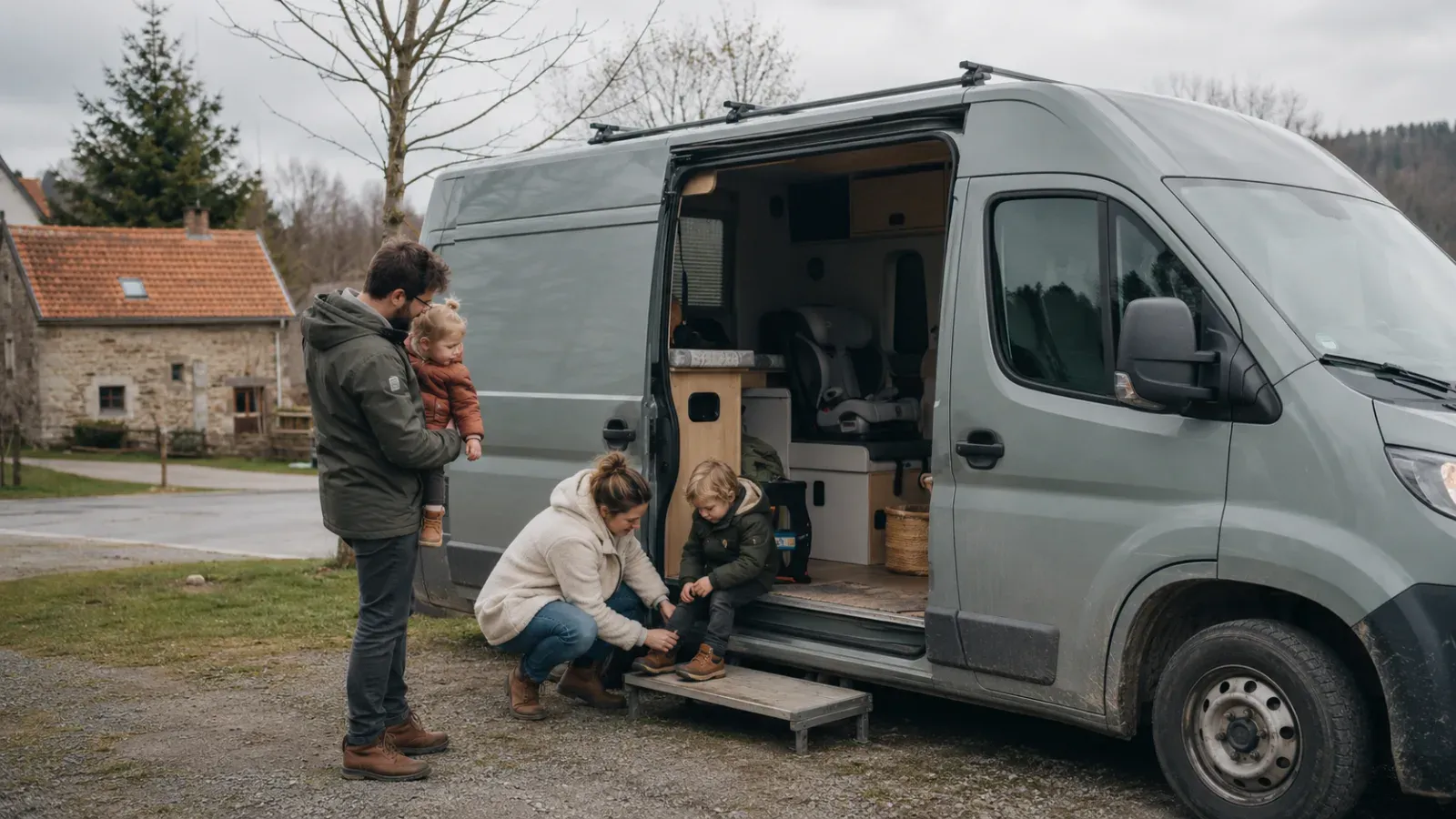
Vanlife with children sounds wonderful. Waking up together in a quiet place, having breakfast outside, hiking, cycling, playing, making up stories, and children learning that travel doesn't always have to be grand or far away.
And it really can be amazing.
But traveling in a van with children is not the same as going alone or as a couple. You need to plan more, consider safety, sleep, toilet, temperature, school, routine, privacy, and belongings more carefully. A small mistake that you can easily fix alone can sometimes turn into a big ordeal with children.
That doesn't mean vanlife with children is impossible. On the contrary. But you do need to look at it realistically.
A child doesn't see a van as "minimalist freedom." A child wants to sleep, eat, play, feel safe, be able to use the toilet, be warm enough, not be stuck for too long, and sometimes just have some space. If you take that into account beforehand, traveling with children will be much calmer.
Don't start with the van, start with your family
The first question isn't: does a bed fit?
The first question is: does this way of traveling suit our family?
Some children love to travel. They sleep easily in new places, play outside, find a small space cozy, and can adapt well to change. Other children need more structure, get carsick easily, sleep poorly in unfamiliar places, or get overstimulated by new sounds and busy campsites.
Look honestly at your family:
- How old are the children?
- Do they sleep easily in a different place?
- Can they handle long drives?
- Do they need a lot of routine?
- Are they easily scared in the dark?
- Can they entertain themselves for a while?
- How do they cope with rain and limited indoor space?
- Do they have medical needs, allergies, or medication?
- Do they need a lot of privacy?
- Do you travel for weekends, holidays, or longer periods?
A toddler requires something completely different than a teenager. A baby requires something different than two school-aged children. And one child in a spacious van is different from three children in a compact van.
Vanlife with children works best if you start from their real needs, not from an ideal image.
First test briefly and close to home
Don't start with three weeks abroad as your first experience.
First, do a short test. An afternoon in the van. An evening drive. A picnic. A nap. One night in the driveway, at family's, at a campsite, or somewhere close to home.
This way, you quickly discover what works and what doesn't.
Perhaps it turns out your child sleeps perfectly, but you have no place for wet shoes. Maybe the bed is fine, but the morning is chaos. Perhaps you notice that the children have too little play space when it rains. Maybe you miss a toilet solution. Perhaps everything is actually better than expected.
A first test close to home is not a weak version of vanlife. It's just smart.
Safe seating while driving is non-negotiable
Before you think about beds, cabinets, or cozy lights, your driving safety must be in order.
Every child must be safely and correctly secured while driving. In Belgium, children under 1.35 meters must be in an appropriate child restraint system. This child seat must be adapted to their height or weight and used correctly.
This seems logical, but with self-built vans, this is sometimes taken too lightly. A wooden bench in the back is not a safe seat. A mattress in the cargo area is not a child's place. Attaching a seatbelt somewhere without approval is not a solution.
Children travel in approved seats with correct seatbelts and child seats. Period.
Also, pay attention to thick coats. A thick winter coat under the seatbelt can create too much slack. Better: take off the coat, buckle the child correctly, and then, if necessary, place a blanket over the child.
Extra seats in a converted van
This is an important point if you still need to build or buy.
A delivery van often only has two or three official seats in the front. If you want children to ride in the back, you need official, approved seats with seatbelts. These must fit within the technical and legal possibilities of the vehicle.
When converting to a camper van or making modifications to the vehicle, you must consider homologation, inspection, and approval. Flanders states that a vehicle must still comply with European legislation after conversion and that an approval procedure may be necessary for conversion to a camper van.
So, don't just install a bench with seatbelts yourself. That's not something to be creative with. Especially not with children.
Are you buying a converted van? Then don't just look at "how many sleeping places" there are, but also at how many official seats are on the registration certificate and where children can sit safely while driving.
Sleeping: cozy isn't enough
Children need a safe place to sleep. Not just a spot where they "can fit somewhere."
Consider:
- can they get in and out safely?
- can they fall out?
- is there enough ventilation?
- is the bed not too close to cooking equipment?
- can they sleep without everyone waking up?
- is the bed warm enough?
- can they retreat?
- does the passage remain clear?
- can you quickly get out if necessary?
A high bed or bunk bed can be handy, but think about fall protection. A child who never falls out of bed at home might move differently in a small bus. Especially if it's dark, the bus is slightly tilted, or they need to go to the toilet half-asleep.
For young children, a low, enclosed sleeping area is often calmer. For older children, privacy becomes more important. A curtain, their own reading light, or a small compartment for personal belongings can make a big difference.
Always keep the exit usable
A van must be livable, but also safe.
Don't place beds, boxes, high chairs, or toys in such a way that you cannot easily use the sliding door or back door. Especially with children, you don't want to have to move everything first if someone feels unwell, needs to go to the toilet, or if you want to leave quickly.
A common mistake is building a bed that looks fantastic in a photo but completely blocks the passage. That's simply not practical with children.
A good family layout always has:
- free access to at least one door
- fixed place for shoes
- fixed place for coats
- night light or lamp within reach
- toiletries accessible
- no loose items in the passage
- sleeping places that are not a stressful puzzle every evening
In a small van, free space is not a luxury. It is safety and peace of mind.
Toilet and nighttime routines
With children, you need to think about the toilet beforehand.
Adults can improvise for a while. With children, that quickly becomes stressful. Especially at night, in the rain, or in a place without sanitary facilities.
Think beforehand:
- where can they go to the toilet?
- is there a campsite or camper place with sanitary facilities?
- do you have an emergency toilet?
- can a child safely go outside at night?
- is there light?
- where do you store toilet paper and hand gel?
- what do you do with waste?
- can your child go to the toilet themselves or do you always have to help?
For young children, a small potty or compact emergency toilet can provide a lot of peace of mind. For older children, privacy is more important. Make agreements about that.
And very important: leave nothing behind. No wipes, no paper, no bags, and no "it's just once." What you take with you, you take until you can dispose of it correctly.
Food: keep it simpler than at home
Cooking with children in a small van can be cozy, but also busy.
At home, you have a kitchen, table, refrigerator, trash can, faucet, and space. In a van, everything is smaller. One hungry child, one pot boiling over, and one rain shower can together be enough to make it chaotic.
Keep meals on the road simple:
- wraps
- pasta
- soup
- sandwiches
- oatmeal
- rice cakes
- fruit
- yogurt
- simple one-pan dishes
- snacks for on the go
Always provide something that is quick to prepare. Children are not always patient when you still have to figure out where the gas lighter is.
Also, think about safe cooking space. Small children and hot pans are not a good combination in a narrow bus. Place cooking equipment stably, keep children out of the cooking zone, and cook with ventilation.
Water is more important than you think
With children, you use more water. Washing hands, drinking, brushing teeth, cleaning faces, accidents, dishes, mud, sand, sticky fingers.
So, provide more water than you would take alone.
Handy:
- water bottles per child
- fixed water bottle in the bus
- small tap or pump
- hand gel as backup
- wipes for emergencies
- washcloths
- small towels
- separate garbage bags
Especially in warm weather, water must always be accessible. Children sometimes feel thirst, fatigue, and heat later than adults. So, you need to pay attention to that.
Never leave children alone in a hot van
This must be very clear: never leave children alone in a hot car or van.
Kind en Gezin (Child and Family) warns that the temperature in a car can rise quickly and that you should never leave your child alone in the car. This also applies to a van. A bus is larger than a passenger car, but remains an enclosed vehicle that can quickly become hot.
Even with a window open. Even in the shade. Even "just five minutes."
With children, you therefore need to plan your day differently. Groceries, sanitary facilities, showering, administration, or picking something up: think beforehand about how you do that without leaving children alone in a hot bus.
In warm weather, it's best to travel with a heat plan:
- park in the shade
- use sun protection
- let children drink enough
- plan walks early or late
- avoid hot parking lots
- ventilate well
- keep an eye on the temperature
- choose campsites or places with shade
- do groceries at cooler times
In a van, temperature is not a detail. It is safety.
Rain is the real test
Vanlife with children is easy on a beautiful summer day. The door open, children outside, eating at a picnic table, playing in the grass.
But Belgium is Belgium. Rain is part of it.
The question is not: is the van cozy in good weather?
The question is: does it also work when everyone has to stay inside?
Think about rainy days:
- where do wet coats hang?
- where do muddy shoes stand?
- can children sit inside without jumping on the bed?
- is there space to draw, read, or play?
- does everything still dry?
- does the bed stay clean?
- does the bus not get too damp?
- can you eat without moving everything?
A wet day teaches you more about your layout than ten sunny photos.
Provide a dirty zone at the door. Shoes off, coats on a hook, wet clothes separately, towel ready. If mud and rain immediately go through the entire bus, it quickly becomes frustrating.
Stuff: less toys, better choice
Children bring stuff. A lot of stuff if you're not careful.
Toys, cuddly toys, books, screens, drawing materials, rain boots, coats, clothes, sleeping gear, snacks, water bottles, school supplies, bike helmets, swimming gear. In a small van, that quickly becomes too much.
The solution is not to forbid everything. The solution is to make choices.
For example, let each child have one small personal bag or box. What fits in it, they can bring. This gives them ownership, but it remains manageable.
Good vanlife items for children:
- small cuddly toy
- drawing book
- colored pencils
- search-and-find book
- card game
- audio stories
- compact outdoor toys
- headlamp
- rain boots
- warm socks
- own water bottle
- small storage bag
Avoid large, loud, fragile, or messy toys. Anything with many parts will be all over the bus after ten minutes.
Screens: handy, but make agreements
Screens can be handy on the road. For a long drive, a rainy evening, or a quiet moment when adults need to cook or plan.
But without agreements, screens quickly become the default.
Make simple rules beforehand:
- when are screens allowed?
- for how long?
- with headphones or without?
- offline downloads for on the go?
- no screen right before bed?
- where are tablets charged?
- where are they stored?
Download movies, series, music, or audio stories via home Wi-Fi beforehand. Then you use less data on the road and are not dependent on mobile internet.
A tablet can be a lifesaver on a difficult day. But it doesn't have to dictate the entire trip.
Rhythm is more important than planning
With children, a strict travel schedule is often a bad idea.
You might think: three places in one day, two walks, groceries, another museum, and then sleep by a beautiful lake. In practice, one child gets tired, someone needs to go to the toilet, it rains, the drive takes longer, and the sleeping place is disappointing.
Better: less planning, more margin.
A good vanlife rhythm with children has:
- short driving days
- fixed rest moments
- enough fresh air
- simple meals
- predictable sleep routine
- time to do nothing
- a backup plan for bad weather
Children often have less need for many kilometers than adults. A simple place with grass, water, a playground, or a forest edge can be better for them than another spectacular destination.
Long drives: plan breaks
Keeping children still for long periods rarely works well.
Kind en Gezin (Child and Family) recommends taking a break every two hours during warm car rides and taking children out of the carrycot or car seat during the break. This is a good habit regardless of the heat.
Breaks make everything better: walking, peeing, drinking, snacking, fresh air, stretching legs.
Make drives child-friendly:
- don't always leave too late
- plan breaks beforehand
- bring quiet activities
- prepare audio stories
- avoid eating while driving if not necessary
- park safely for snacks
- keep water accessible
- provide sun protection
- keep spare clothes nearby
A three-hour drive can easily become five hours with children. Just count on that.
School and compulsory education
For weekends and holidays, this is simple. For longer trips with school-aged children, you need to think carefully.
In Belgium, there is compulsory education for children aged 5 to 18. This does not mean that every child is obliged to attend a traditional school, as homeschooling is possible, but it is regulated. So, you cannot just leave for months during the school year and assume that everything will work out.
For children of compulsory school age, you need to consider beforehand:
- do we only travel during school holidays?
- is consultation with the school necessary?
- are absences allowed?
- is homeschooling an option?
- what are the rules and obligations?
- how do we keep up with learning material and structure?
- what about exams, assignments, or evaluations?
For a long vanlife trip with children, this is a separate project. Not something to arrange afterwards.
Travel documents and permission
If you are going abroad with children, make sure your documents are in order.
For Belgian children under 12, there is the Kids-ID. This serves as an electronic identity document and travel document within Europe and is valid for a maximum of three years. Apply for them in time at your municipality.
Children aged 12 and older have a regular electronic identity card. For travel outside Europe, a passport may be required, depending on the country.
If you are traveling as a single parent with a child, it may be wise to bring written permission from the other parent. Foreign Affairs indicates that you can put the written agreement of the other parent on paper, have the signature certified by the municipality, and bring that permission with you. If the parent and child do not have the same surname, a copy of the birth certificate can help to prove kinship.
Always check the rules of your destination. Some countries are stricter than others.
Privacy and age
A toddler primarily needs proximity. A teenager needs space.
That's a big difference.
Young children often find it cozy to sleep close to everyone. Older children may not want everything to always be together: getting dressed, sleeping, arguing, being tired, reading, being alone for a while.
In a small van, privacy is limited, but not impossible.
Consider:
- curtains around beds
- own compartment per child
- headphones
- outdoor moments
- clear agreements about changing clothes
- not just touching each other's belongings
- respect for sleep rhythm
- occasionally booking a campsite or room for more space
A family in a van needs not only physical space, but also mental space.
Conflicts grow larger in a small space
In a house, someone can go to another room. In a van, they cannot.
Arguments, fatigue, hunger, and overstimulation therefore feel greater. Especially in bad weather.
Prevent as much as possible by keeping basic things in order:
- don't let children get hungry for too long
- enough breaks
- fixed sleep routine
- not too many activities in one day
- clear division of tasks
- everyone has their own spot
- adults who remain calm themselves
That last one is perhaps the most difficult. If you are stressed about parking, cooking, or rain, children feel that immediately.
Vanlife with children requires not only a good van, but also slower travel.
Hygiene with children
Children get dirty. That's not a problem in itself. But in a small van, you need a system for it.
Provide:
- wet wipes for emergencies
- washcloths
- hand gel
- liquid soap
- separate laundry bag
- small towels
- spare clothes nearby
- garbage bags
- place for wet shoes
- place for muddy coats
- toothbrushes in a fixed place
Washing without a fixed shower is perfectly possible, but with children, you need to keep it simple. A washcloth and a little warm water do a lot. Occasionally plan a campsite, swimming pool, or sports center for a real shower.
Make handwashing a regular habit, especially before eating and after using the toilet.
Laundry and spare clothes
With children, you have laundry faster.
An accident, wet socks, mud, spilled chocolate milk, rain pants, pajamas, towels. Don't bring endless amounts of clothes, but smartly chosen spare clothes.
Handy:
- quick-drying clothes
- multiple pairs of socks
- spare pants nearby
- warm sweater
- rain jacket
- comfortable shoes
- separate bag for dirty laundry
- clothesline and clothespins
- microfiber towels
Thick cotton items dry slowly. In a damp Belgian van, that can become annoying. So, prefer clothes that dry quickly and can take a beating.
Safety at the location itself
As soon as you stop, safety changes.
Children jump out of the bus, run around, play, cycle, or explore. But a camper place, campsite, or parking lot is not an enclosed garden.
Pay attention to:
- traffic at campsites and parking lots
- water nearby
- other people's dogs
- hot cooking appliances
- campfires or barbecues
- bicycles and scooters
- steep edges
- unknown people
- darkness
- open sliding door along the road
Make clear agreements. How far can they go? Do they need to remain visible? Can they go to the toilet block alone? What do they do if they can't find you? Where is the bus?
A small whistle or recognizable light can be handy for older children at campsites, but never replaces supervision.
Cooking and fire safety
A van is a small space with wood, textiles, gas, electricity, hot pots, and moving children.
Cooking must therefore be done calmly.
Create a clear cooking zone. Children stay out of it while cooking. Place pans stably. Use lids where possible. Don't leave hot drinks on an edge. Ventilate well. Don't use a cooking appliance as heating.
A small fire blanket, smoke detector, and possibly a CO detector are not an exaggerated luxury. Especially if you work with gas or a combustion appliance.
Also explain to children what is hot. Not dramatically, just clearly: this is not a play zone.
Involve children in the trip
Children often enjoy traveling more if they can participate.
Let them help with small tasks:
- tidying their own bag
- putting shoes in their place
- filling water bottles
- looking at the route together
- collecting trash
- helping to make the bed
- leaving the place clean
- checking the weather forecast
- choosing a walk
This way, the van doesn't become a place where adults control everything, but a shared system.
Don't make it too serious. A child doesn't have to become a mini-adult. But small responsibilities provide peace and structure.
Don't expect every day to be beautiful
On social media, family vanlife often seems magical. Children in blankets, parents with coffee, sunset, perfect camper, everyone happy.
In reality, there are also days with rain, arguments, carsickness, wet socks, bad nights, overcrowded parking lots, mess, fatigue, and children who just want to go home.
That's part of it.
A bad day doesn't mean vanlife with children has failed. It means you are traveling with a family in a small space. Sometimes that's beautiful. Sometimes that's just difficult.
Therefore, occasionally plan for comfort:
- campsite with sanitary facilities
- playground
- swimming pool
- library
- pancake stop
- laundry moment
- visit to family
- day without driving
- hotel or cottage as a reset
Vanlife doesn't have to be tough or minimalist every day.
What do you really need?
A basic list for vanlife with children:
- official seats and correct child seats
- identity documents or Kids-ID
- possibly parental consent when traveling with one parent
- warm sleeping gear
- blackout or curtains
- ventilation
- toilet plan
- water and water bottles
- simple meals
- snacks
- spare clothes
- rain gear
- washcloths and towels
- garbage bags
- first aid kit
- medicines if necessary
- small toys or books
- offline entertainment
- headlamp or night light
- fixed storage bin per child
- plan B for bad weather
You don't need everything from a family home. But the basics must be right.
What would I definitely test beforehand?
Before you leave for longer, test these things:
- do all children sleep okay in the van?
- is there enough ventilation?
- do they get in and out of bed safely?
- does the passage remain clear?
- are the seats and child seats correct?
- does the toilet plan work?
- can you cook without stress?
- where do wet clothes go?
- where are shoes?
- do children have enough to do when it rains?
- how do they react to outside noises?
- how does the morning routine go?
- what happens when everyone is tired?
A weekend test says more than weeks of planning on paper.
My practical advice
Vanlife with children can be very beautiful, but you have to be honest about the reality.
Children need less than we sometimes think, but they do need clear basic things: safety, sleep, food, warmth, rest, toilet, movement, and predictability. If these are missing, travel quickly becomes stressful.
I would start small. First one night, then a weekend, then longer. Don't immediately choose the most remote places. Use campsites or camper places if that gives peace of mind. Don't overfill your van. And build your layout around real family moments, not around perfect photos.
A van with children doesn't have to be Instagram-worthy. It has to work on a rainy evening, with hungry children, wet shoes, and someone who urgently needs to go to the toilet.
If that works, you're good.
Vanlife with children is slower, but richer
Traveling with children in a van requires more preparation. You need to think about official seats, child seats, documents, school, warmth, sleep, privacy, hygiene, and rhythm.
But if you handle these basics well, you get a lot back.
Children learn to live outdoors. They see small places. They learn that comfort doesn't always have to be grand. They make memories that are not about luxury, but about being together, discovering, and living on the road.
Vanlife with children is not always quiet. Not always easy. Not always clean.
But with realistic expectations, it can be one of the most beautiful ways to travel as a family.
Source: https://www.kindengezin.be/nl/thema/reizen-met-kinderen/op-vakantie/veilig-onderweg
Source: https://www.ibz.rrn.fgov.be/nl/burger/identiteitsdocumenten/kids-id
Source: https://diplomatie.belgium.be/nl/reisadviezen/klaar-voor-vertrek/reizen-met-minderjarige-kinderen
Source: https://www.vlaanderen.be/onderwijs-en-vorming/leerplicht/leerplicht-van-5-tot-18-jaar