Your first night in the van: what you should know beforehand
Your first night in the van is special. A little exciting, a little unfamiliar, and often less perfect than you might have imagined beforehand.
By Laurens De Leeuw · 9 July 2026
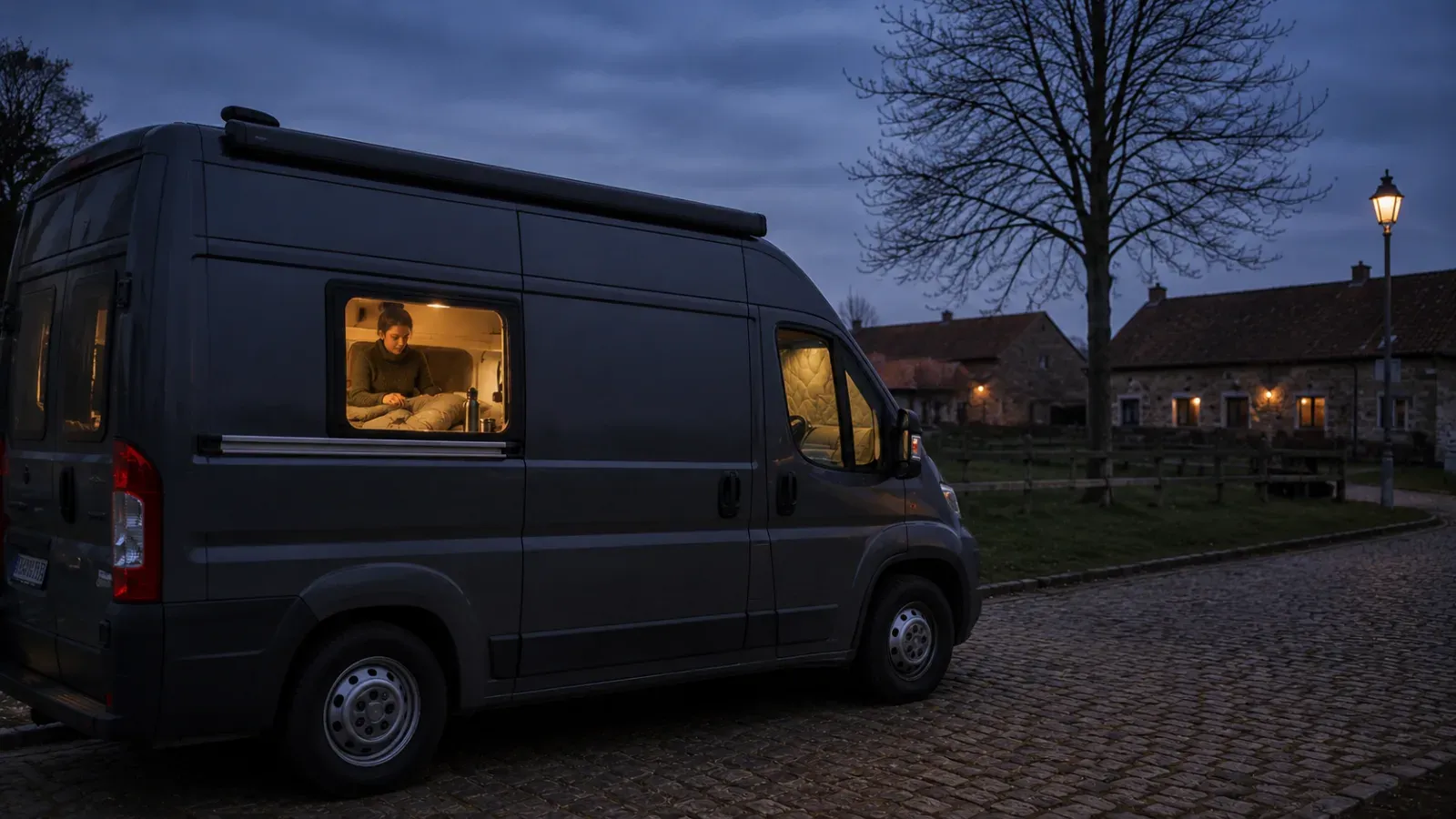
Your first night in the van is special. A little exciting, a little unfamiliar, and often less perfect than you might have imagined beforehand.
You're in a small space. You hear every sound outside. You suddenly start thinking about things you never consider at home: Am I parked correctly? Can people see me? Is it cold? Where will I go to the toilet? What if someone knocks? Do I have enough ventilation? Why is the van creaking all of a sudden?
That's normal.
The first night isn't about the perfect vanlife experience. It's about getting used to it. To your van, to your routine, to sleeping in a different place, and to the idea that your small vehicle is suddenly your bedroom.
If you approach it smartly, that first night will be much calmer. Perhaps not spectacular, but pleasant. And that's exactly what you need to build confidence.
Don't make your first night too adventurous
The biggest mistake is wanting to start too grandly right away.
A remote forest parking lot, bad weather, no toilet nearby, a half-empty battery, no clear sleeping spot, and zero experience: that might sound adventurous, but it's not an ideal first night.
For your first time, choose an easier spot. A campsite, campervan site, a friend's driveway, private land with permission, or a quiet place close to home. The goal isn't to prove you can sleep anywhere. The goal is to learn how your van works.
Sleeping close to home is not boring at all. On the contrary. If something is missing, you'll know immediately. If you sleep poorly, you're quickly back. And if everything goes well, you'll have confidence for the next trip.
Your first night is a test, not an exam.
Choose your spot with less stress
Where you park determines how well you sleep.
A spot can be technically beautiful, but still not feel right. Too dark, too remote, too busy, too much traffic, too sloped, too loud, or just a strange feeling. Listen to that.
For a first night, this is more important than the view:
- you are legally parked
- you feel safe
- you are not in the way
- you are not too conspicuous
- you can easily drive away
- you might have a toilet nearby
- you are reasonably level
- you have mobile reception
- you know where you can go if you do want to leave
A beautiful spot where you lie tense all night is not a good spot. A simple campervan site where you sleep peacefully is much better.
Parking is not the same as camping
This is an important distinction.
Parking your vehicle is one thing. Displaying camping behavior is another. Think of putting out chairs, opening the awning, unfolding a table, cooking next to the van, hanging laundry, discharging wastewater, or clearly setting up your camp.
In many places, a parked van is less likely to be seen as a problem than a vehicle that is clearly camping. But that doesn't mean you can just stay overnight anywhere. Rules can vary by municipality, parking lot, nature reserve, or property owner.
So, pay attention to signs, local rules, and common sense.
In nature reserves in Flanders, you are not allowed to wild camp or pitch your tent just anywhere. Natuur en Bos refers to bivouac zones for this, which are primarily intended for people traveling on foot or by bike and require reservations. So, "just going to sleep in the woods" with a van is not a good starting plan.
If you really want a carefree start, choose an official campsite or campervan site. Then you know that overnight stays are permitted there, and you often have water, waste disposal, electricity, or sanitary facilities nearby.
Check the basics before dark
Everything is easier in daylight.
Before dark, make sure you know how your bed works, where your lamp is, how your doors close, where your keys are, and where your belongings are. You don't want to be searching for your toothbrush, power bank, or sleeping bag at 11 PM.
Before you go to sleep, do a quick check:
- bed ready
- curtains or window insulation in place
- phone charged
- keys in a fixed spot
- water within reach
- flashlight or headlamp ready
- ventilation open
- shoes in a fixed spot
- toilet plan clear
- trash removed
- cooking gear stowed away
- escape route clear if you need to leave
That sounds exaggerated, but it brings peace of mind. Especially the first time.
Make sure you can leave quickly
You don't have to be afraid, but you do need to stay practical.
Park your van so you can easily drive away. Don't park completely hemmed in, not with your nose in a spot where it's difficult to get out, and not on ground where you could get stuck in the rain.
Keep your driver's seat accessible. Don't place boxes, shoes, or bags in such a way that you have to tidy up for ten minutes before you can leave.
You probably won't have to leave. But knowing you can makes sleeping more peaceful.
Your keys also belong in a fixed spot. Not deep in a jacket pocket, not under a blanket, not in a bag at the back. Choose one spot and always use it.
Ventilation is not an option
Many people close everything tightly on the first night because they want to feel safer or warmer. But a small van quickly becomes damp.
You exhale moisture all night. If there's no air circulation, you'll get condensation on the windows, stale air, and a clammy feeling. Especially in Belgium, where the air is often humid.
So, always leave a little ventilation open. That could be a roof hatch ajar, a window vent, a small window with a wind deflector, or a fan on a low setting. You don't need a draft blowing through your van, but air must be able to move.
Do you wake up with wet windows? That's normal, especially at first. Wipe them dry and air out your van for a bit. But also see it as feedback: maybe there needs to be a bit more ventilation next time.
Consider temperature
A van cools down faster than a house. Even in spring or summer, it can get colder at night than you think.
For your first night, it's better to bring a little too much warmth than too little. An extra blanket, warm socks, a hat, fleece, or sleeping bag can make the difference between cozy and miserable.
A few practical things:
- sleep in dry clothes
- have warm socks ready
- use a good sleeping bag or duvet
- ensure insulation under your mattress
- keep an extra blanket within reach
- bring a hat in cold weather
- avoid wet clothes in your bed
Cold from below is often underestimated. A thin mattress on a cold floor quickly feels unpleasant. Make sure your body is well insulated.
Keep your bed simple
Your first night is not the time for a complicated conversion system you've never tested.
Test your bed at home or in the driveway. Can you set it up alone? Does it stay firm? Is it long enough? Can you turn over? Where do you put your pillow during the day? Can you still access your belongings when the bed is unfolded?
A good bed doesn't have to be fancy. It mainly needs to be quick to set up, firm, and not a puzzle every time.
If your bed causes fifteen minutes of frustration every evening, you'll quickly grow to hate it.
Privacy brings peace of mind
In a house, you don't think about windows. In a van, you suddenly do.
Without curtains, window insulation, or blackout, you quickly feel exposed. Even if no one is looking. You see streetlights, headlights, passersby, and shadows. That often makes the first night more restless.
So, provide privacy. This can be very simple:
- curtains
- magnetic covers
- thermal mats
- window insulation
- dark fabric with clips
- simple window covers
Make sure it's not too obvious from the outside that someone is sleeping, but also don't make it completely airtight inside. Privacy and ventilation must work together.
Sounds are much louder at night
The first night, you hear everything.
A branch against your roof. Rain on metal. Someone walking by. A car parking. A cyclist. An animal. Your refrigerator. Your heater. The wind. Your own van creaking as it cools down.
That doesn't mean something is wrong.
Your brain is simply alert because you're sleeping in a new place. After a few nights, that gets better.
Earplugs can help, but use them wisely. You want peace, but also enough awareness of your surroundings. A soft background noise, like rain or a fan, can sometimes also be soothing.
Your toilet plan must be clear
This may not be the most romantic topic, but it is one of the most important.
Before you go to sleep, you need to know what you'll do if you need to go to the toilet at night. Especially in a parking lot, in bad weather, or when there are no sanitary facilities nearby.
Possible solutions:
- campsite or campervan site with sanitary facilities
- public toilet nearby
- small emergency toilet
- urinal or pee bottle
- emergency toilet bag
- make arrangements if you're traveling with two people
Don't start your first night without a plan. That only causes stress.
Do not use nature or the street as a toilet. Do not leave paper, wipes, or trash behind. What you take with you, you also take back until you can dispose of it correctly.
Food and drink: keep it simple
Don't make your first night culinarily too complicated.
A simple meal is enough. Soup, pasta, wraps, sandwiches, instant noodles, heating something up, or even just eating at home before you leave. The goal is to test sleeping, not immediately cook a three-course meal in a small van.
If you do cook, do so safely and with ventilation. Use a cooking appliance for its intended purpose, place it stably, and don't cook among loose clothes, blankets, or clutter.
Drink enough, but also consider your toilet plan. Drinking three large teas right before bed on the first night might not be ideal.
Do not use cooking fires as heating
A cooking appliance is for cooking, not for keeping your van warm.
Gas, petroleum, charcoal, or other combustion appliances can be dangerous with poor ventilation. Carbon monoxide is dangerous because you cannot see, smell, or taste it. Flanders warns that CO can be released during poor combustion of, among other things, gas, wood, coal, fuel oil, and petroleum.
So, do not use a gas stove, barbecue, camping stove, or open flame as heating in your van.
Do you have a combustion appliance on board, such as gas or a diesel heater? Ensure correct installation, ventilation, and a CO detector. A smoke detector is also wise. That might sound exaggerated for a first night, but safety in a small sleeping space is not a detail.
Battery and phone
Your phone is more than entertainment during your first night. It's your map, flashlight, alarm clock, emergency contact, payment method, and weather app.
Make sure it's charged. Bring a power bank. If necessary, prepare offline maps if you're somewhere with less reception.
Also handy:
- charging cable in a fixed spot
- power bank full
- flashlight separate from your phone
- emergency numbers accessible
- share location with someone if you're traveling alone
- enable battery saving if you have low power
If you're sleeping alone in a new place, it can be reassuring to let someone know your approximate location. Not because there's immediate danger, but simply as a healthy habit.
Light: not too bright, but accessible
A headlamp or small light is much handier than you think.
You don't want to brightly illuminate your entire van at night because you're looking for something. A small warm light or headlamp is enough to find shoes, look outside, or grab something.
Place your light in a fixed spot. Not somewhere "approximately there." In a dark van, "approximately" is very annoying.
Red or warm light is more pleasant than bright white light when you've just woken up. But the most important thing is that you have light without having to search for it.
Safety without paranoia
You don't have to be afraid of everything. But a few simple habits will make your first night calmer.
- lock your doors
- keep keys handy
- don't leave valuables visible
- park with a clear exit
- trust your gut feeling
- avoid places where you don't feel welcome
- stay sober enough to still be able to react
- keep your driver's seat accessible
- don't set up camp where it doesn't belong
- leave if a place feels wrong
That last point is important. You don't have to defend your choice. If a place doesn't feel right, drive on. Even if you're tired. Even if the view is beautiful. Even if you "had already decided" to stay there.
Looking for another place is not a failure. It's smart.
Sleeping alone feels different
Sleeping alone in your van can feel strange at first. You are both free and vulnerable. Everything is your responsibility: choosing a spot, locking doors, assessing sounds, toilet plan, departure route, morning routine.
That gets easier.
Make it easy for yourself. For your first night, don't choose an extremely remote spot. Get everything ready. Optionally, share your location with someone you trust. Agree with yourself that you can simply leave if you're not comfortable.
Traveling with two often feels safer, but has other challenges: less space, more condensation, more noise, more stuff. Even then, a good routine is important.
With a dog or children: test even simpler
If you're traveling with a dog or children, make your first night extra simple.
With a dog, you need to know where it sleeps, where its leash is, where you can walk in the evening, and how to keep wet paws out of your bed. For Grephar, for example, I would immediately provide a fixed spot for his blanket, water bowl, leash, and towel. Otherwise, everything will be scattered after one evening.
With children, it's mainly about comfort and reassurance. Where do they sleep? Can they easily go to the toilet? Is it dark enough? Are they warm? What if they wake up?
Then, for your first night, prefer a campsite or stay with friends. Not because it's impossible otherwise, but because you'll have fewer things to solve at once.
Don't fill everything up
During your first night, you'll quickly realize how important free space is.
When your bed is ready, your bags need to go somewhere. When you take off your shoes, they need a place. When you brush your teeth, your toiletry bag needs to be accessible. When your wet jacket comes in, it shouldn't end up on your bed.
So, plan a simple evening layout:
- shoes by the door
- jacket on a hook
- toiletries in one bag
- sleepwear accessible
- dirty laundry separate
- cooking gear stowed away
- water bottle within reach
- keys and lamp in a fixed spot
A small van doesn't get messy due to one big problem. It gets messy due to twenty small things without a place.
The morning is part of the test
Many people only think about the night itself, but the morning teaches you at least as much.
How quickly can you tidy up your bed? Is everything wet from condensation? Can you make coffee? Where do you put your sleeping bag? How does the van feel after one night? Did you sleep well? What did you miss?
Take some time in the morning to see what worked and what didn't.
A good morning routine:
- wipe away condensation
- briefly ventilate
- air out bedding
- collect trash
- check water and toilet
- put things back in their fixed spots
- leave the spot clean
- note what you'll do differently next time
Leave your spot as if you were never there. No trash, no wipes, no water, no mess, no traces. That's not only respectful, it also helps keep vanlife welcome.
What you probably forget
Everyone forgets something on their first night. That's normal.
Many forgotten things:
- earplugs
- extra socks
- headlamp
- trash bag
- toilet paper
- hand sanitizer
- window cloth for condensation
- power bank
- water bottle
- comfortable sleepwear
- slippers or slip-on shoes
- hook for jacket
- small towel
- warm hat
- charger
- something simple for breakfast
After your first night, make a list. Not by feeling, but immediately. What did you miss? What was in the way? What didn't you use? That list is gold for your next trip.
What not to do on your first night
A few things make your first night unnecessarily difficult.
Don't do:
- arrive in the dark at an unfamiliar place
- leave without a toilet plan
- close everything tightly
- sleep with wet clothes in bed
- cook without ventilation
- leave valuables visible
- choose a remote spot that doesn't feel right
- put out chairs and a table where it's not appropriate
- drink alcohol if you might still need to move
- fill your van so much that you can't move
- stay because you "are already here anyway"
Keep it simple. Your first night should build confidence, not stress.
A good first night setup
For your first night, I would bring this:
- mattress, sleeping bag or duvet
- extra blanket
- warm socks and sleepwear
- window covers or curtains
- flashlight or headlamp
- charged phone
- power bank
- water bottle
- simple meal or snacks
- toilet paper and hand sanitizer
- trash bag
- small towel
- cloth for condensation
- earplugs
- slippers or easy shoes
- jacket within reach
- CO detector if you work with combustion appliances
- smoke detector as a basic safety measure
That's not luxury. That's just a calm foundation.
The best first night is often boring
Perhaps that's the most important insight: a good first night is often a bit boring.
You arrive. You prepare your bed. You eat something simple. You close your curtains. You hear some sounds. You might not sleep perfectly, but okay. In the morning, you make coffee, wipe away condensation, and think: that actually went quite well.
That's exactly what you want.
After that, you can become more adventurous. Other places, longer trips, worse weather, more freedom. But don't start with the most difficult version.
Vanlife grows with experience. Your first night is just step one.
Confidence comes from testing
After your first night, you'll know much more than before.
You'll know if your bed is comfortable. If your ventilation works. If you were warm enough. If your spot was well chosen. If your belongings were logically placed. If your toilet plan works. If your van is damp in the morning. If you felt safe.
No YouTube video can fully teach you that. You have to do it.
So keep your first night simple, respectful, and safe. Choose a place where you are allowed to stay or where overnight stays are provided. Don't set up camp where it doesn't belong. Leave nothing behind. Ventilate. Keep your keys handy. And leave if it doesn't feel right.
The first night doesn't have to be perfect. It mainly needs to teach you how you and your van work together.
And if you wake up in the morning, make coffee, and think "I want to do this again," then it was a success.
Source: https://natuurenbos.vlaanderen.be/faq/mag-ik-kamperen-een-bos-natuurgebied
Source: https://www.wegcode.be/nl/regelgeving/2024005817~0mocswfbry
Source: https://toerismevlaanderen.be/nl/logies/uitbatingsnormen-camperterrein
Source: https://www.veiligverkeer.be/veilig-rijden/slaperigheid/wegcode-parkeren-slapen-auto/